Photonics Initiative Seminar: Igor Aharonovich

Dr. Igor Aharonovich, University of Technology Sydney Quantum Technologies with Hexagonal Boron Nitride Abstract - Engineering robust, solid‐state quantum systems is amongst the most pressing challenges to realise scalable quantum photonic circuitry. In recent years, quantum emitters in hexagonal boron nitride (hBN) have emerged as fascinating candidates for realisation of room temperature quantum technologies with

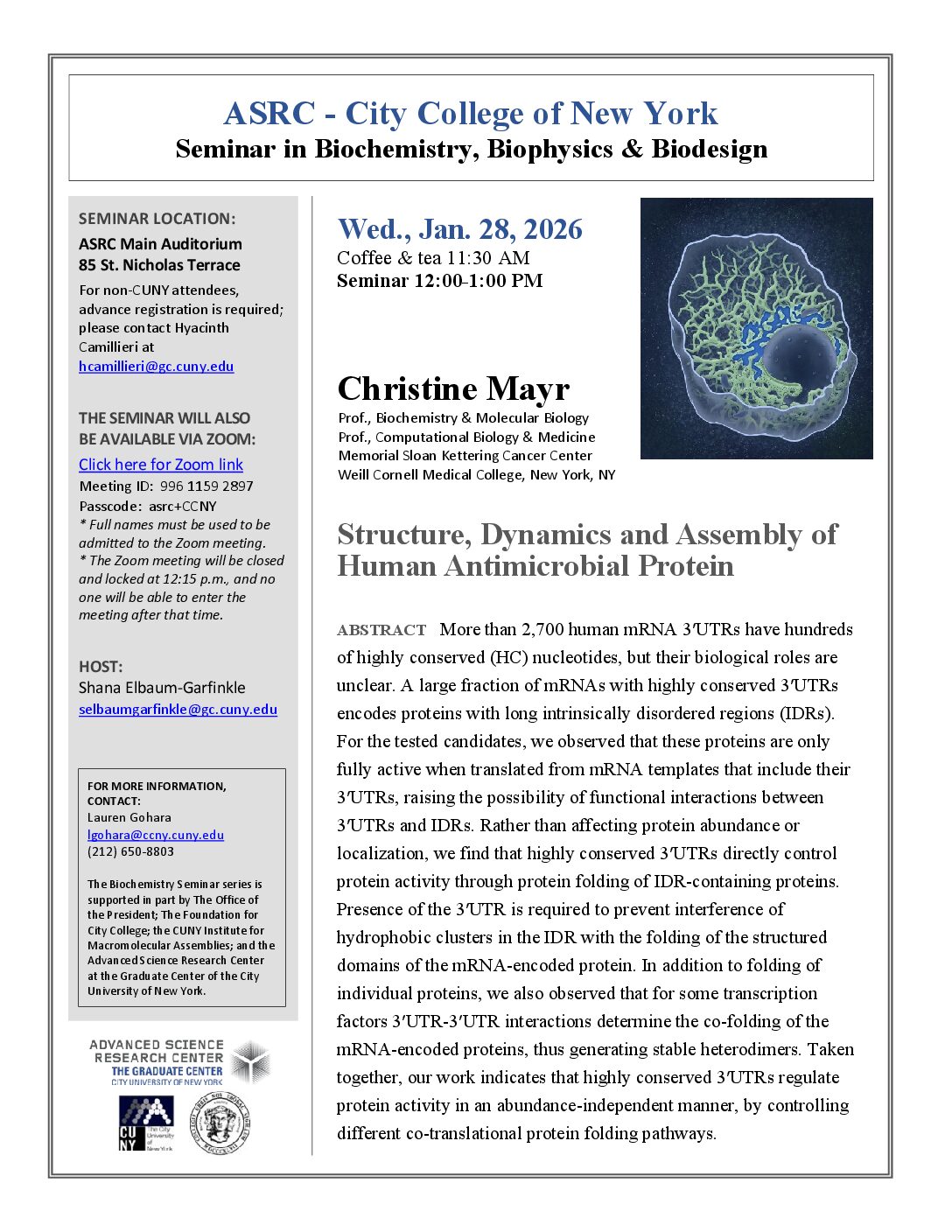
Fall ’25 Biochem Seminar: Associate Professor Rupal Gupta

Structure, Dynamics and Assembly of Human Antimicrobial Protein Antimicrobial proteins in humans sequester zinc to curtail infection. Although well established as key components of the immune response, the mechanisms of action of these proteins, such as S100A12, in the inflammatory pathway is not well understood. In this talk, I will present our work on biophysical

Photonics Initiative Seminar: Matthew White

Dr. Matthew White, University of Vermont Host: Matthew Sfeir Metal-dielectric photonic crystal organic light emitting diodes: band structure, defect engineering, and topological states. Abstract: We investigate the band structure of metal-dielectric photonic crystals comprising stacked organic semiconductor microcavities with silver metal mirrors. Employing organic semiconductor dielectric layers allows the unit cells in the crystal to

Photonics Initiative Seminar: Siddhartha Ghosh

Dr. Siddhartha Ghosh, Northeastern University Acoustic wave microsystems for chip-scale RF and optical signal processing Abstract:  Acoustic waves are well-suited for a variety of signal processing applications including RF filtering and optical modulation. Advances in material and fabrication capabilities have enabled the demonstration of chip-scale subsystems in which phonons can exhibit strong interactions with a

Fall ’25 Biochem Seminar: Professor Olga Boudker

Dynamics and Evolution of Glutamate Transporters Glutamate transporters in the human brain remove the neurotransmitter glutamate from the synaptic cleft, enabling repeated cycles of neurotransmission and preventing glutamate-induced excitotoxicity. These transporters are ancient proteins that, in prokaryotes, serve to import amino acids as nutrient sources from the environment. Across evolution, glutamate transporters have diversified to

Fall ’25 Biochem Seminar: Professor Peter B. Moore

Structural Biology: Past, Present and Future Between ~1950 and ~2010, X-ray crystallography was the experimental technique of choice for determining the structures of biological macromolecules at atomic resolution. It is no longer. Around 2012, following a long gestation, electron microscopy emerged as a serious competitor, and about a decade later, AI-based computational methods were developed

Photonics Initiative Seminar: Francesco Valenti

Correlation length of radiation-induced errors in superconducting devices Abstract - Superconducting quantum electronics are a promising avenue towards fully fledged quantum computation. They are currently limited by their short coherence times, stemming from their sensitivity to perturbations, which include... very tiny earthquakes! I will show recent work where we measured six superconducting resonators using nanosecond-resolution

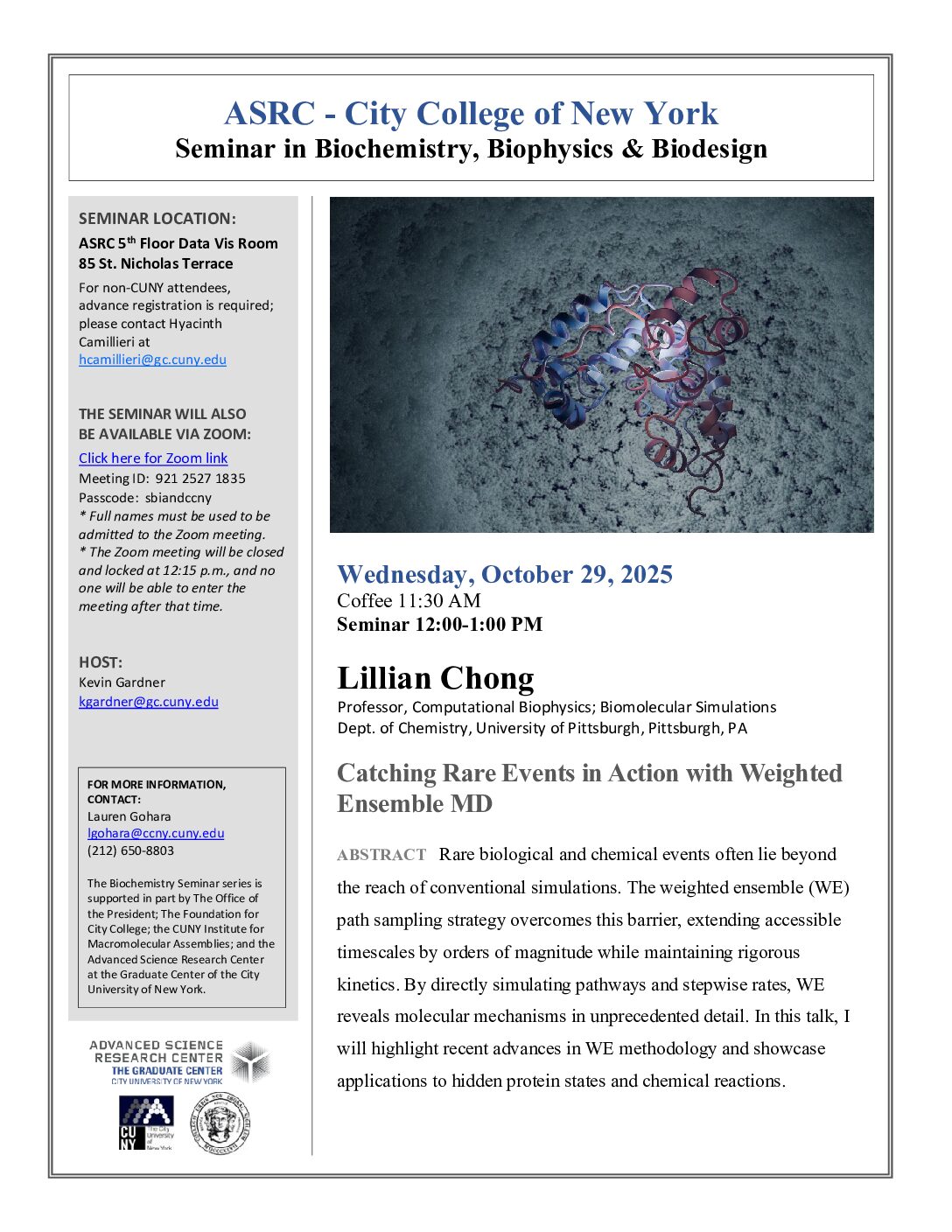
Fall ’25 Biochem Seminar: Professor Lillian Chong

Catching Rare Events in Action with Weighted Ensemble MD Rare biological and chemical events often lie beyond the reach of conventional simulations. The weighted ensemble (WE) path sampling strategy overcomes this barrier, extending accessible timescales by orders of magnitude while maintaining rigorous kinetics. By directly simulating pathways and stepwise rates, WE reveals molecular mechanisms in

Photonics Initiative Seminar: Maria Antonietta Loi

Dr. Maria Antonietta Loi, University of Groningen COLLOIDAL QUANTUM DOT SUPERLATTICES: TOWARDS OPTOELETRONIC METAMATERIALS Abstract – 3D superlattices made of colloidal quantum dots are a promising candidate for the next generation of optoelectronic devices as they are expected to exhibit a unique combination of tunable optical properties and coherent electrical transport through minibands. In my

Fall ’25 Biochem Seminar: Professor Michael Sattler

Dynamic RNA-protein interactions in A-to-I editing and biomolecular condensates in non- coding RNA pathways We employ integrative structural biology, combining solution NMR with complementary techniques and molecular dynamics to study the dynamics of RNAs and RNA-protein interactions in RNA processing pathways, including alternative splicing regulation and non- coding RNA pathways. The structural understanding is a

Fall ’25 Biochem Seminar: Associate Professor Kimberly Reynolds

Mapping and modeling the impact of protein biochemical variation on growth rate phenotype Individual proteins can be expressed, purified, and exquisitely characterized in terms of their biochemical and biophysical parameters in vitro. However, the quantitative relationship between these parameters and complex phenotypes like growth remains mysterious. For example, what values of protein abundance, thermal stability

Nanoscience Guest Speaker: Coordination Self-Assembly: From Origins to the Latest Advances – Dr. Makoto Fujita

Register HERE! Space is limited. Abstract: Molecular self-assembly based on coordination chemistry has made an explosive development in recent years.  Over the last >30 years, we have been showing that the simple combination of transition-metal’s geometry (typically, a 90 degree coordination angle of Pd(II) center) with organic bridging ligands gives rise to the quantitative self-assembly

Photonics Initiative Seminar: Junichiro Kono

Dr. Junichiro Kono, Rice University Cavity-Dressed Quantum Matter Abstract - There has been a growing realization that the properties of a material can be modified just by placing it in an optical cavity. The quantum vacuum fields surrounding the material inside the cavity can cause nonintuitive modifications of electronic states through ultrastrong vacuum–matter coupling, producing a

Photonics Initiative Seminar: Giulio Cerullo

Dr. Giulio Cerullo, Polytechnic University of Milan 2D semiconductors: a platform for ultrafast photonics Abstract - Layered materials consist of crystalline sheets with strong in-plane covalent bonds and weak van der Waals out-of-plane interactions. These materials can be easily exfoliated to a single layer, obtaining 2D materials with radically novel physico-chemical characteristics compared to their bulk

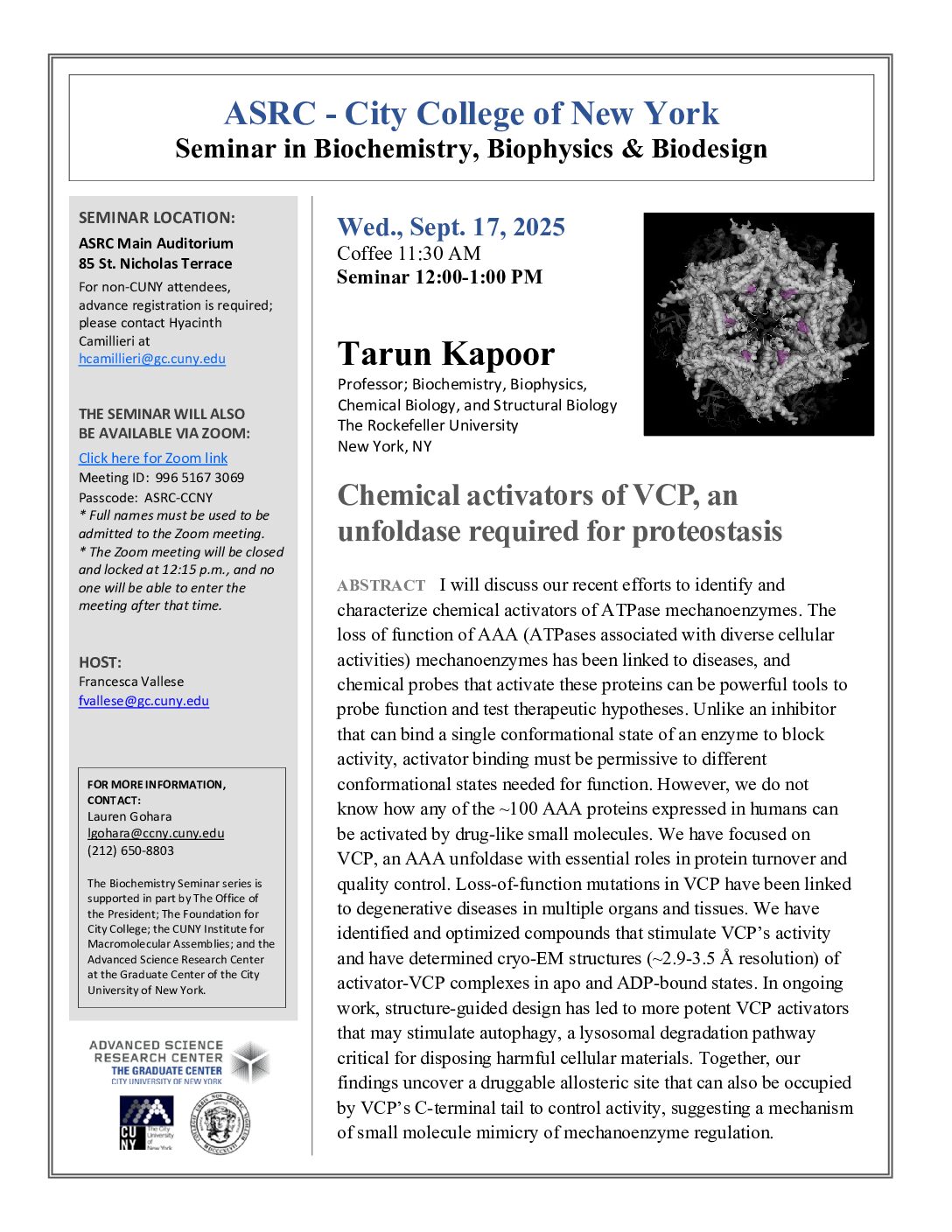
Fall ’25 Biochem Seminar: Professor Tarun Kapoor

Chemical activators of VCP, an unfoldase required for proteostasis I will discuss our recent efforts to identify and characterize chemical activators of ATPase mechanoenzymes. The loss of function of AAA (ATPases associated with diverse cellular activities) mechanoenzymes has been linked to diseases, and chemical probes that activate these proteins can be powerful tools to probe

Fall ’25 Biochem Seminar: Associate Editor Antonio Cerullo

Publishing in Structural Biology, Biochemistry, and Biophysics Scientific progress and publishing are fundamentally intertwined. Therefore, scientists must master both the pipette and the pen. Antonio Cerullo (CUNY ASRC – Ph.D. in Biochemistry '23) shares his professional and personal experiences transitioning from bench science to an editorial career. Points of discussion include, but are not limited

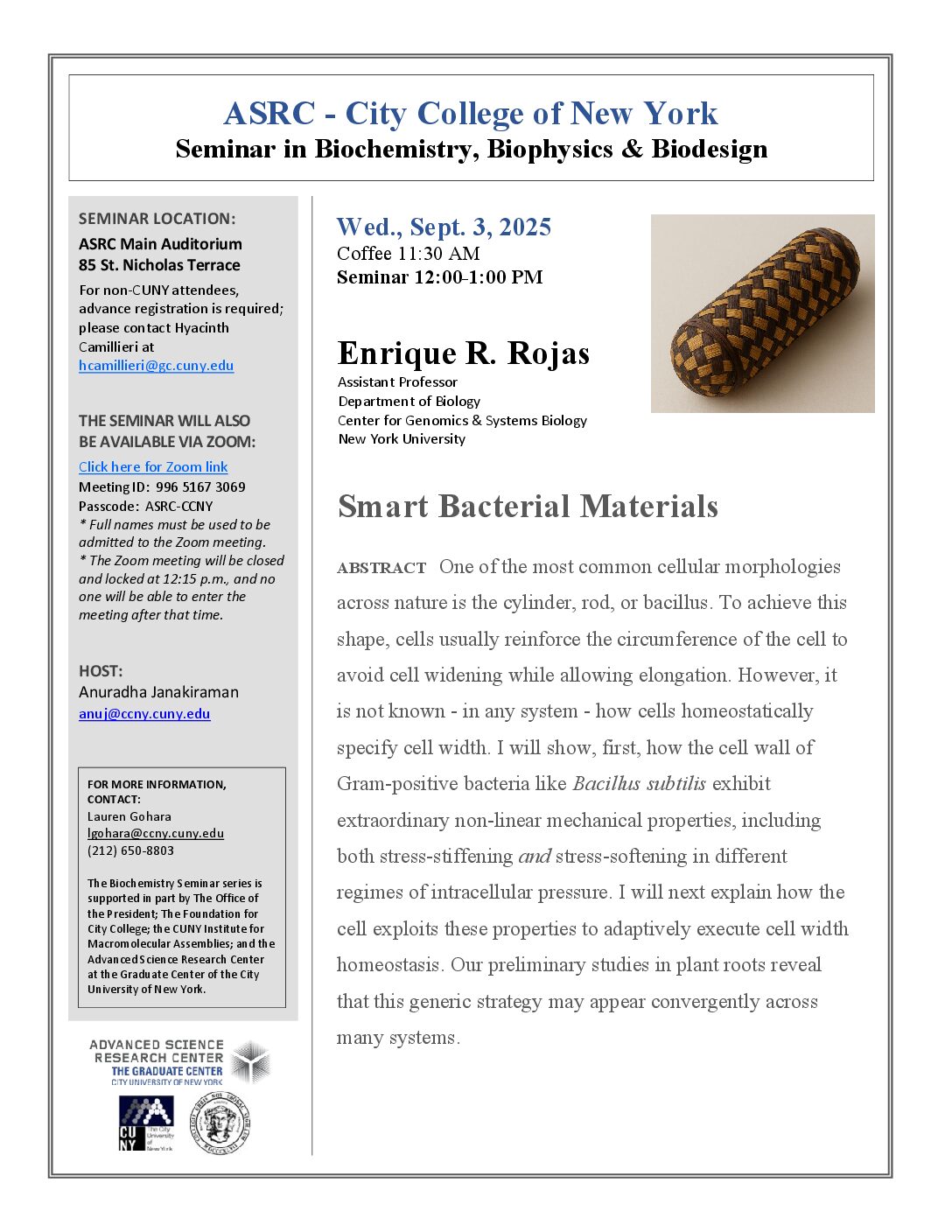
Fall ’25 Biochem Seminar: Assistant Professor Enrique R. Rojas

Smart Bacterial Materials One of the most common cellular morphologies across nature is the cylinder, rod, or bacillus. To achieve this shape, cells usually reinforce the circumference of the cell to avoid cell widening while allowing elongation. However, it is not known - in any system - how cells homeostatically specify cell width. I will

Photonics Initiative Seminar: Yohannes Abate

Dr. Yohannes Abate, The University of Georgia There’s Plenty of Interaction at the Bottom Abstract – The formulation of quantum mechanics in the late 1920s forever changed physics. More recently, quantum materials have emerged, presenting fascinating opportunities in condensed matter physics. Elementary interactions among elements such as photons, electrons, phonons, and other quasiparticles in quantum

Photonics Initiative Seminar: Sergio Carbajo

Dr. Sergio Carbajo, UCLA Quantum Filmmaking: Capturing and Controlling Ultrafast Dynamics from Atoms to Applications Abstract – The ability to visualize and control quantum systems in action—spanning attosecond electron dynamics to functional protein motions—holds transformative potential for science and technology. Over the past decade, advances in ultrafast photon and electron sources, such as optical frequency

Photonics Initiative Seminar: Mohammed Hassan

Dr. Mohammed Th. Hassan, University of Arizona From Attosecond Electron Microscopy Imaging To Petahertz Quantum Photonics Abstract - We present groundbreaking advancements in ultrafast electron microscopy, quantum current tunneling in graphene, and ultrafast squeezed light, establishing transformative capabilities in attosecond science and technology1,2. First, we achieved attosecond temporal resolution in a transmission electron microscope by

Two-part Photonics Initiative Seminar

This is a two-part Photonics Initiative Seminar, the first part describing information in light structure and the second part about structuring light in the lab. Dr. Eileen Otte Beyond the Beam: The Potential of Light’s Structure When light interacts with a medium, its spatial structure – including amplitude, phase, polarization, angular momenta, and more –

Photonics Initiative Seminar: Angel Rubio

Dr. Angel Rubio, Max Planck Institute Cavity Quantum Electrodynamics for Quantum Materials Design   Angel Rubio Max Planck Institute for the Structure and Dynamics of Matter, Luruper Chaussee 149, 22761 Hamburg, Germany Initiative for Computational catalysis (ICC) and Center for Computational Quantum Physics (CCQ) Flatiron Institute,  10010 NY, USA Abstract - A central challenge in

Photonics Initiative Seminar: Andrea Fiore

Dr. Andrea Fiore, Eindhoven University of Technology. Nanophotonics on the Tip of a Fiber Abstract - By transferring nanopatterned semiconductor membranes on the tip of optical fibers, we combine the power of nanophotonics with the flexibility of fiber sensing. In this talk I will discuss a variety of fiber-tip sensors of physical and biochemical parameters

Photonics Initiative Seminar: Danial Motlagh

Dr. Danial Motlagh,  Xanadu Title: A Renaissance in Materials Discovery Abstract - Quantum computers have the potential to transform materials discovery for next-generation technologies from a slow and expensive trial and error process into a fast, cost-effective, simulation-driven endeavour. In this talk, I’ll share our vision for a quantum-accelerated materials discovery pipeline and the regimes

Interdisciplinary Seminar Series featuring Associate Professor Dr. Xi Chen

EvapoFlex: Water-responsive Materials for Evaporation Energy Harvesting Many important physiological functions of living organisms (e.g., plant seed dispersal, bacterial spore activation) rely on water-responsive (WR) materials that mechanically deform in response to changes in relative humidity. Recently, biological WR materials have been shown to generate significantly higher energy actuation compared to all known animal muscles

Photonics Initiative Seminar: Arthur D. Yaghjian

Dr. Arthur D. Yaghjian (Electromagnetics Research) Robust Field-Based Antenna Quality Factor Abstract – New field-based quality factors Q(ω) are derived for antennas with known fields produced by an input current. These Q(ω) are remarkably robust because they equal the input-impedance bandwidth quality factor QZ(ω) when the input impedance is available. Like QZ(ω), the field-based Q(ω)

Photonics Initiative Seminar: Armando Genco

Armando Genco (Politecnico di Milano) Ultrafast dynamics of coherent exciton-polaritons in van der Waals semiconductor metasurfaces Abstract - Metasurfaces based on transition metal dichalcogenides (TMDs) have emerged as a promising platform for controlling light at the nanoscale due to their exceptional optical properties, including strong excitonic responses and intrinsically high refractive index. Unlike traditional dielectric metasurfaces,

Photonics Initiative Seminar: Marc Serra Garcia

Dr. Marc Serra Garcia (AMOLF) Physical computing in metamaterials Abstract - There is a significant range of physical phenomena—from nonlinear elasticity, to symmetry, noise, topology, and disorder — that are rarely utilized in traditional computing paradigms. Yet these phenomena can unlock new efficiencies, by directly processing signals in their natural domain, and by bypassing the

Photonics Initiative Seminar: Jacob Khurgin

Dr. Jacob Khurgin (Johns Hopkins University) Coherent Frequency Combs in Mid-Infrared and THz Produced By Self Frequency Modulated Quantum Cascade Lasers For many applications Optical Frequency Combs (OFCs) require a high degree of temporal coherence and thus narrow linewidth1 as well as wide bandwidth (i.e. many spectral lines.  Commonly OFCs are generated in some nonlinear

Guest Speaker: Steve Eichhorn, PhD

Using Cellulose to Store and Harvest Energy Abstract: This talk will cover the use of cellulosic materials for the harvesting and storage of energy. The talk will cover the history of cellulosic materials used in both batteries and capacitors, introducing the use of nanocellulose, and carbon materials derived from this material for use as electrodes

Photonics Initiative Seminar: Giuseppe Strangi

Dr. Giuseppe Strangi (Case Western Reserve University) Thin-Film Photonics: Enabling Fano Resonances and Optomechanics Abstract – In recent years, significant interest has emerged in the inverse design1 of artificial layered heterostructures for photonic applications2. Specifically, the unique optical properties of near-zero permittivity (ENZ) metamaterials have enabled the exploration of novel physical effects and mechanisms. In

Photonics Initiative Seminar: Mikhail Belkin

Dr. Mikhail Belkin, Technical University of Munich (TUM) New Applications for Nonlinear Intersubband Polaritonic Metasurfaces: from beam shaping to THz generation Abstract - Quantum-engineered intersubband transitions in n-doped multiple-quantum-well heterostructures allow one to produce semiconductor films with very large nonlinear optical response. This nonlinear response can be further enhanced by processing semiconductor heterostructures as metasurfaces

Photonics Initiative Workshop: Cristiano Matricardi

Publishing in Nature Journals workshop. Day 1 (January 23rd) 10am-11:30am - Seminar on writing, science publishing and editorial decision making Understanding the role of editorial evaluation is crucial, especially in today's dynamic landscape where diversity is ever-present yet often overlooked. This talk will explore the three key stages of research and publishing: effectively identifying current

Photonics Initiative Seminar: Giovanni Milione

Dr. Giovanni Milione NEC Laboratories America, Inc. Vector Beams and Space Division Multiplexing Abstract – In this talk, I will overview two areas of my research at NEC Laboratories America, Inc.: For plane wave solutions to Maxwell’s equations, light’s polarization is understood. Not so for structured light. In this talk I’ll discuss non-trivial higher-order solutions

Photonics Initiative Seminar: Simo Pajovic

Simo Pajovic Department of Mechanical Engineering, Massachusetts Institute of Technology Controlling Light-Matter Interactions in Novel Emitters: Thermal Radiation, Scintillation, and Beyond Abstract - In mechanical engineering, thermal radiation is the best-known example of light-matter interactions, but non-thermal radiation is prevalent in a wide variety of applications, including medical imaging, manufacturing, and sensing. Scintillation—the emission of light

Photonics Initiative Seminar: Levent Sevgi (IEEE DL lecture)

Dr. Levent Sevgi IEEE AP-S Former DL – DLPC Chair ITU - Istanbul Technical University (Emeritus) From Engineering Elecromagnetics to Electromagnetic Engineering:Teaching/Training Next Generations Abstract - The role of Electromagnetic (EM) fields in our lives has been increasing. Communication, remote sensing, integrated command/ control/surveillance systems, intelligent transportation systems, medicine, environment, education, marketing, and defense are

Photonics Initiative Seminar: Mu Wang

Dr. Mu Wang National Laboratory of Solid State Microstructures, School of Physics, and Collaborative Innovation Center of Advanced Microstructures, Nanjing University, Nanjing 210093, China Manipulating Light with Optical Metasurfaces: from Classical to Quantum Abstract - This talk focuses on the interaction of electromagnetic waves with metamaterials and manipulating the polarization state of light, which are

Photonics Initiative Seminar: David Burghoff

Nonlinear Photonics in the Mid-Infrared and Terahertz Abstract – Optical sensing at long wavelengths presents significant opportunities and significant challenges. The longwave infrared and terahertz ranges are renowned for their potential to sense molecules in a variety of contexts, such as high-speed chemical imaging, disease detection, and environmental monitoring; however, their promise has yet to

Photonics Initiative Seminar: Giovanni Toso and Piero Angeletti

Multi-Beam Antennas (MBAs) and Beam-Forming Networks (BFNs) Abstract - Distinguished Speakers Giovanni Toso and Piero Angeletti from European Space Agency, Netherlands will present the state of the art and the on-going development in Multi-Beam Antennas (MBAs) and Beam-Forming Networks (BFNs). They find applications in several fields including communications, remote sensing (e.g. radars, radiometers, etc.), electric surveillance

Guest Speaker: Tanja Weil, PhD

Synthesis of Interactive Peptide Nanostructures in Living Systems Tanja Weil, PhD Max Planck Institute for Polymer Research, Germany Abstract- We explore controlled chemical reactions in complex living systems to generate drug molecules, synthesize peptide nanofibers, or build new cellular compartments. The introduction of bioresponsive groups enables us to control peptide self-assembly inside the living cell.

Photonics Initiative Seminar: Yakir Hadad

Exact formulation of the mutual particle-cavity dynamics and its use for the study of loss threshold phenomenon under magnetization Abstract – Light-matter interaction plays a pivotal role in pushing forward nanotechnology. A particularly important setup involves a resonating particle, say an emitting molecule or a macroscopic quasi-statically resonating plasmonic or ferromagnetic sphere, that is located

Photonics Initiative Seminar: Guancong Ma

Non-Abelian Braiding with Sound and Light Abstract – Many physics laws and mathematical rules are insensitive to order. For example, the addition of numbers disregards the sequence order, e.g., 1+2+3=3+1+2. However, such a commutative property does not always hold. When the outcomes of a set of operations depend on the execution order, they can become

Seminar in Biochemistry, Biophysics, and Biodesign

The SBI Initiative of the ASRC presents Benjamin S. Schuster, Assistant Professor of the Department of Chemical and Biochemical Engineering at Rutgers, The State University of New Jersey, speaking on "Negative noodles, and positive ones too: Engineering intrinsically disordered proteins".

Photonics Initiative Seminar: Michael Scalora

Light-Matter Interactions at the Nanoscale: Harmonic Generation from Metal/Vacuum Interfaces and Novel Aspects of Radiation Reaction Abstract – In noble metals a patina of free electrons extends out into free space and vanishes within a fraction of an atomic diameter. We discuss the possibility and consequences of the existence of such a free electron layer,

Guest Speaker: Dr. Ayala Lampel, PhD

Charge-Mediated Interactions Affect Enzymatic Reactions in Peptide Condensates Ayala Lampel, PhD Shmunis School of Biomedicine and Cancer Research, George S. Wise Faculty of Life Sciences, Tel Aviv University, Tel Aviv, Israel. Center for Nanoscience and Nanotechnology Tel Aviv University, Tel Aviv, 69978, Israel Sagol Center for Regenerative Biotechnology Tel Aviv University, Tel Aviv, 69978, Israel

Seminar in Biochemistry, Biophysics & Biodesign

Come see Associate Professor Reginald McNulty speak on the "Innovative Drug Inhibition and Unexpected Glycosylase Activity for Therapeutic Advancements" Wednesday September 11th.

Spring 2024 Neuroscience Initiative Seminar Series

Join the ASRC Neuroscience Initiative for this monthly seminar series welcoming speakers from around the country exploring numerous topics on environmental factors in relation to neurodevelopment, the use of AI in interdisciplinary research and more.

Fall 2023 Photonics Seminar Series: Margherita Maiuri, Politecnico de Milano

Ultrafast nanophotonics: harnessing light and manipulating matter through femtosecond multidimensional spectroscopies Abstract – Ultrafast manipulation of light-matter interactions in photonic nano-architectures has unlocked unprecedented opportunities in the field of nanophotonics, ranging from high speed signal processing to the control of photophysical material functionalities. Especially, using optical means, e.g. femtosecond laser light pulses, to actively drive

4-part lecture series with Prof. Eitan Bachmat

Join the ASRC Photonics Initiative in this 4-part lecture series with Prof. Eitan Bachmat, exploring, "A multidisciplinary journey in science and technology, from airplane boarding to designing lenses in hyperbolic metamaterials via space-time geometry." To participate registering here by Tuesday 9/5/23. Lecture dates include: Wednesday September 6, 2:00pm - 5:00pm Friday September 8, 1:00pm - 4:00pm Monday

CUNY Radiation Safety Training

This CUNY-wide radiation safety training will take place in-person at the ASRC Auditorium from 10am-3pm, with a midday break from 12-1pm.

Photonics Seminar: Albert Polman, AMOLF

In this one-hour seminar, Albert Polman, Center for Nanophotonics, NWO Institute, AMOLF, will be presenting a talk titled: Optical metasurface performing mathematical operations and making better solar cells.

Converge to Transform Seminar: Ting Xu, UC Berkeley

Please join us for a one-hour talk, as part of the ASRC's Converge to Transform: Interdisciplinary STEM Seminar Series, from Professor Ting Xu, University of California, Berkeley.

Guest Speaker and Graduate Center Alum, Dennis C. Liotta, Ph.D.

We are excited to announce Dr. Dennis C. Liotta, a Graduate Center alum, will be presenting a talk titled: “Novel Therapeutics for Treating Cancers, Neurological Disorders and Viral Diseases,” at the ASRC on Friday Oct. 28th.