
All Facilities | All Instruments
Biomolecular Mass Spectrometry Facility

The CUNY ASRC Biomolecular Mass Spectrometry Facility provides analytical services and expertise in mass spectrometry to CUNY researchers, industrial partners, and academic laboratories outside the University. The facility supports projects across structural biology with particular expertise in hydrogen–deuterium exchange mass spectrometry (HDX-MS) and untargeted metabolomics. Representative applications include characterization of protein conformational dynamics and interactions, intact proteins, biopharmaceuticals, complex peptide mixtures, metabolites, PEGylated biopolymers, self-assembling biomaterials, and spatial molecular analysis of tissues by mass spectrometry imaging.
The facility maintains an high-resolution Bruker maXis-II ETD ESI-qTOF mass spectrometer equipped with Dionex Ultimate 3000 U(H)PLC and RS nano-LC systems, a Bruker NeofleX MALDI TOF-TOF, and a Bruker timsTOF fleX MALDI-2 instrument. The Bruker timsTOF fleX MALDI-2 serves as the primary platform for HDX-MS, enabling studies of protein higher-order structure and conformational dynamics.
The facility provides untargeted metabolomics workflows using high-resolution LC-MS and ion mobility separations for broad molecular profiling and identification of metabolites in complex biological samples. The integration of accurate mass measurements, tandem MS, ion mobility, and advanced data analysis tools enables comprehensive metabolite characterization and improved molecular annotation.
The facility offers training on HDX-MS workflows, untargeted metabolomics, NeofleX MALDI TOF-TOF, and timsTOF fleX MALDI-2 instrumentation for researchers planning extensive independent use of the equipment.
This Core Facility uses iLab. Please click on the button below for instructions to request access and use our services.
Facility Details
-

Bruker timsTOF fleX ›
The Bruker timsTOF fleX combines trapped ion mobility spectrometry (TIMS) with high-resolution QTOF mass spectrometry to provide advanced capabilities for hydrogen-deuterium exchange mass spectrometry (HDX-MS) with HDX-LEAP robotics system, untargeted metabolomics, and proteomics. For HDX-MS, the system enables high-confidence peptide identification through exceptional mass accuracy, resolving power, and ion mobility separation, improving the analysis of complex peptide mixtures and increasing sequence coverage for detailed characterization of protein conformational dynamics, ligand binding, and protein-protein interactions. In untargeted metabolomics, TIMS enhances molecular annotation by providing an additional gas-phase separation dimension and collision cross section (CCS) measurements, improving discrimination of isomeric species, reducing chemical interferences, and increasing metabolome coverage. For proteomics, the instrument offers highly sensitive peptide detection, broad dynamic range, and reproducible analysis of complex biological samples, supporting both protein identification and quantitative workflows. Together, these capabilities provide a comprehensive platform for structural biology and systems-level molecular analysis with exceptional sensitivity, selectivity, and reproducibility.
-

Bruker NeofleX MALDI TOF/TOF ›
The Bruker NeofleX MALDI TOF/TOF mass spectrometer provides a versatile platform for the analysis of intact proteins, synthetic polymers, DNA, and other high-molecular-weight biomolecules. High mass accuracy, broad mass range, and rapid data acquisition enable sensitive characterization of biomolecular masses, sample heterogeneity, and molecular integrity with minimal sample preparation. The instrument's MALDI Top-Down Sequencing (MALDI-TDS) capability provides rapid structural characterization of intact proteins by generating sequence information directly from the protein without prior enzymatic digestion, delivering immediate insight into the primary amino acid sequence, N- and C-terminal status, and near-terminal post-translational modifications. Together, these capabilities provide a robust platform for biopharmaceutical characterization, quality control, polymer analysis, and structural analysis of intact biomolecules with high speed, sensitivity, and analytical confidence.
-
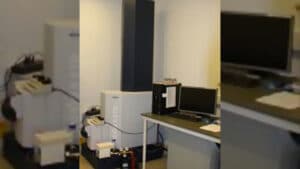
Bruker maXis-II ETD ESI-qTOF ›
The Bruker maXis-II ESI QqTOF mass spectrometer combines ESI with high-resolution (up to 80,000 resolving power), accurate-mass analysis and ETD to provide a versatile platform for HDX-MS, online size-exclusion chromatography-mass spectrometry (SEC-MS), and other LC-MS applications. For HDX-MS, the instrument supports manually controlled workflows that enable specialized sample preparation and experimental protocols beyond automated robotic handling. Integrated online SEC-MS enables rapid analysis of intact proteins and protein complexes under native conditions, facilitating the assessment of molecular weight, oligomeric state, sample heterogeneity, and noncovalent interactions. The ETD capability provides complementary fragmentation for structural characterization of peptides and proteins while preserving labile post-translational modifications. For routine LC-MS experiments, the instrument offers highly sensitive, reproducible analysis of small molecules, peptides, and proteins with broad dynamic range and robust quantitative performance. Together, these capabilities provide a flexible analytical platform for structural biology, biopharmaceutical characterization, metabolomics, and general biomolecular mass spectrometry studies.


Standard Service by Staff
| Academic Rate – CUNY | Academic Rate – External | Start-Up | Industry | |
| 1Standard MM by ESI-MS | $50/sample | $60/sample | $100/sample | $150/sample |
| 1Standard MM by MALDI-MS | $50/sample | $60/sample | $80/sample | $150/sample |
2Advanced Data Acquisition/Analysis
| Academic Rate – CUNY | Academic Rate – External | Start-Up | Industry | |
| HDX-MS / Omics-projects | $50/hour | $55/hour | $80/hour | $150/hour |
| Native-ESI-MS / SEC-MS of proteins | $50/hour | $55/hour | $80/hour | $150/hour |
| 3 Staff-run data analysis | $50/hour | $55/hour | $80/hour | $150/hour |
4User-Run
| Academic Rate – CUNY | Academic Rate – External | Start-Up | Industry | |
| maXis-II-ETD ESI-QqTOF | $50/hour | $55/hour | $80/hour | $150/hour |
| AutoFlex-TOF-TOF | $40/hour | $50/hour | $65/hour | $100/hour |
1 Standard mass measurement (MM) by ESI-MS in direct infusion (DI) or LC-MS mode may include between 1 – 3 hours of method development time at $50/hour fee.
2 Advanced data acquisition/analysis (minimum 2 hours) implies usage of maXis-II-ESI-Qq-TOF mass-spectrometer in combination with HDX-LEAP robotics, Dionex-3000 and/or Nano-LC systems. This type of analysis includes e.g., HDX-MS, Native-ESI-MS, online Size-Exclusion-MS analysis of proteins, targeted phosphorylated sites analysis, various metabolomics projects. Our regular academic users will receive discounts (please contact Dr. Rinat Abzalimov for details).
3 Staff-run Data analysis implies usage of Metaboscape-2022, HDExaminer-3.3 and other software, and preparation of preliminary data analysis report
4 Our Monday-Friday user-booking policies: max 2 days / week per instrument in advance instrument booking. Minimum usage time – 0.5 hour
Please download Sample Submission Form and fill it out electronically using Adobe Acrobat. Submitter and sample information parts must be filled out completely. Print out the form and attach your labeled sample at the top-right corner of the form (within “attach your sample here” box). We ask internal/external users to deliver samples with completed submission forms to:
CUNY Advanced Science Research Center
Mass Spectrometry Core Facility, SBI 3rd floor
85 Saint Nicholas Terrace
New York, NY 10031
General Information on Sample Preparation
Water, methanol, acetonitrile, tetrahydrofuran, propanol, ethanol, toluene, dichloromethane, nitromethane are MALDI-MS and ESI-MS compatible solvents, whereas non-volatile solvents as e.g. dimethilformamide or dimethyl sulfoxide are not (though tolerable in small amounts) – so please avoid using them. Protein samples for ESI or MALDI MS should be prepared using ultra-pure water (MilliQ 18MΩ cm, or LC-MS grade bottled water). Common buffers (Tris-HCl, HEPES, phosphate buffers, NaCl) are also not compatible with direct infusion ESI-MS analysis as they cause suppression of ESI/MALDI signal and/or extensive adduct formation. Appropriate volatile buffers for protein intact mass analysis include formic acid (up to 1%), acetic acid (up to 5%), ammonium acetate (up to 150mM), ammonium formate (up to 10mM), ammonium bicarbonate (up to 20 mM) and ammonium hydroxide.
Measurement accuracy expected at Low-Res is about +-0.05 Da for ESI-MS methods. Mass accuracy at High-Res is better than 5ppm and needed in general for publication purposes.
For more information, please contact:
-
Rinat Abzalimov, Ph.D.
- Director, Mass Spectrometry Facility
- Co-Director, MALDI-TOF MS Imaging Facility
- Research Associate Professor, Structural Biology Initiative
Phone: 212.413.3236
