
Alumni and Friends Community Science Night
Join us on Tuesday, Dec. 16 to reconnect and learn all about what's happening at the CUNY ASRC! All are welcome — especially former and current students, interns, summer researchers,

Convening meetings, workshops, seminars, and public programs is a key part of the mission at the Advanced Science Research Center at the CUNY Graduate Center promoting collaboration between campus-based faculty, ASRC faculty, theorists, and experimentalists across New York City.
The ASRC offers event and meeting spaces that can accommodate up to 100 guests for your next conference, reception, meeting, workshop, film shoot, or private event.
Join us on Tuesday, Dec. 16 to reconnect and learn all about what's happening at the CUNY ASRC! All are welcome — especially former and current students, interns, summer researchers,
Get ready for a hands-on exploration of the single cell gene expression analysis journey! This interactive boot camp takes you from experimental design to data interpretation using real single-cell datasets

Learn how academics can promote their research and make useful connections on Bluesky.

"Harnessing dynamic covalent chemistry for reprocessable elastomers" Dr. Luke A. Baldwin, Research Chemist, Air Force Research Labs (AFRL) Abstract: Covalent adaptable networks (CANs) are a promising route to develop next-generation

Anna Orr, Ph.D., Associate Professor of Neuroscience at Weill Cornell Medical College, will give a talk titled "Astrocytes in Neurocognitive Function and Dementia Pathogenesis". Join in person at the ASRC
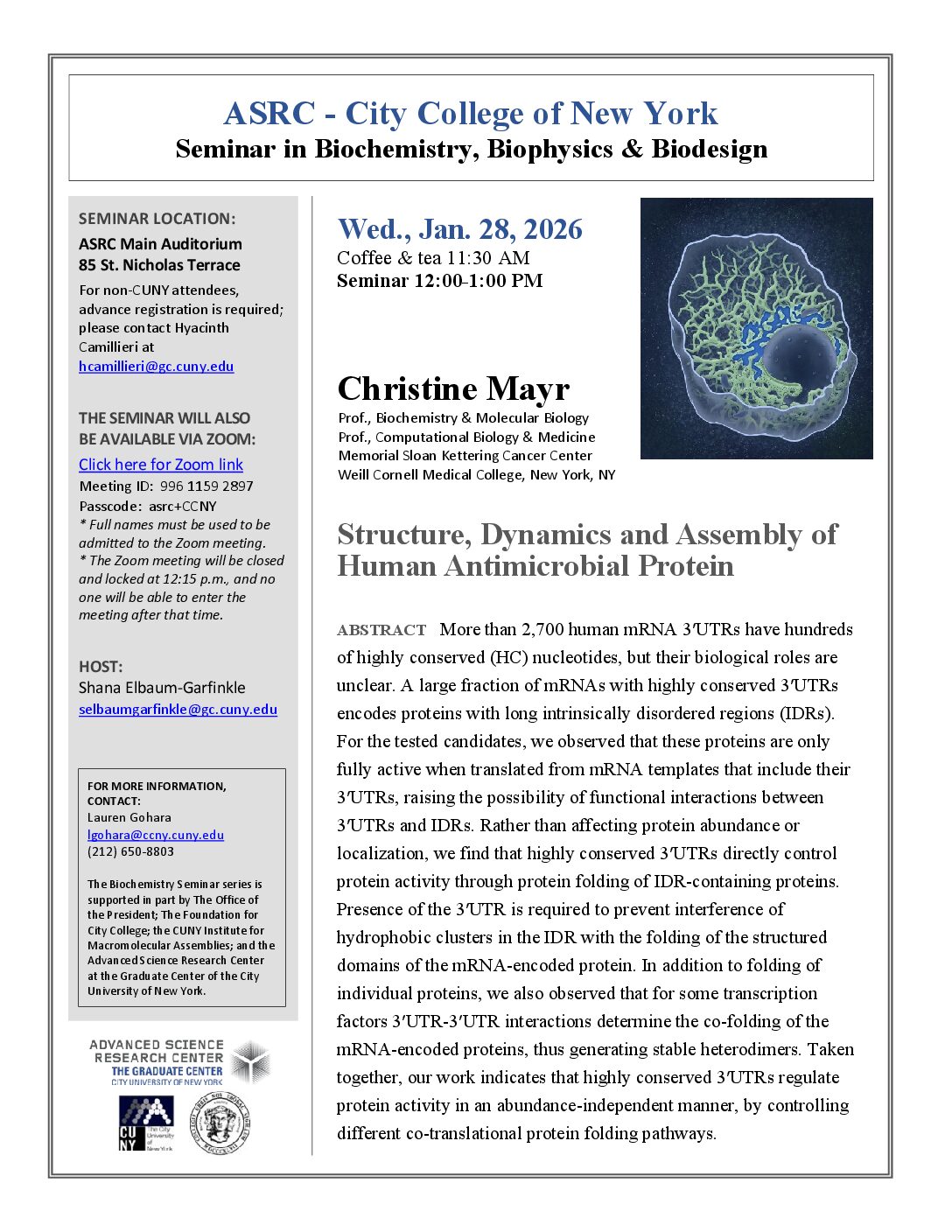
Structure, Dynamics and Assembly of Human Antimicrobial Protein More than 2,700 human mRNA 3′UTRs have hundreds of highly conserved (HC) nucleotides, but their biological roles are unclear. A large fraction
Join us for a practical, beginner-friendly workshop on how academics can use LinkedIn to showcase their expertise, expand professional networks, and increase the visibility of their research and teaching. This session will
Dr. Rainer Hillenbrand, CIC nanoGUNE Polaritonic Insights from Near-field Nanoscopy: Flat-Band Ultrastrong Coupling and Plasmons in Gold Monolayers Abstract - Scattering-type scanning near-field optical microscopy (s-SNOM) and nanoscale Fourier-transform infrared

Patrizia Casaccia, M.D., Ph.D., Einstein Professor of Biochemistry, Biology and Neuroscience of the CUNY Graduate Center, Founding Director of ASRC Neuroscience Initiative, will give a talk titled "A multiscale approach
Dr. Itai Cohen, Cornell University Electronically Integrated Autonomous Microscopic Robots Abstract - What would we be able to do if we could build electronically integrated machines the at a scale

Talk Topic: Distributed AI Agents for Scientific Discovery and Real-World Decision-Making Speaker Bio: Saptarashmi Bandyopadhyay is a Tenure-Track Assistant Professor of Computer Science at the City University of New York
How a novel class of protein misfolding is associated with changes in enzyme activity, proteostasis, aging, and disease Utilizing simulations, experimental data, and data science, my lab predicted the existence
Dr. Javier Garcia De Abajo (ICREA)
For any questions, please contact Hyacinth Camillieri at hcamillieri@gc.cuny.edu
For any questions, please contact Hyacinth Camillieri at hcamillieri@gc.cuny.edu
For any questions, please contact Hyacinth Camillieri at hcamillieri@gc.cuny.edu
For any questions, please contact Hyacinth Camillieri at hcamillieri@gc.cuny.edu
For any questions, please contact Hyacinth Camillieri at hcamillieri@gc.cuny.edu